Search This Blog

Tuesday, May 31, 2011

Other Words For Love by Lorraine Zago Rosenthal


Other Words for Love

What it's about (from Goodreads): When an unexpected inheritance enables Ari to transfer to an elite Manhattan prep school, she makes a wealthy new friend, Leigh. Leigh introduces Ari to the glamorous side of New York--and to her gorgeous cousin, Blake. Ari doesn't think she stands a chance, but amazingly, Blake asks her out. As their romance heats up, they find themselves involved in an intense, consuming relationship. Ari's family worries that she is losing touch with the important things in life, like family, hard work, and planning for the future.

When misfortune befalls Blake's family, he pulls away, and Ari's world drains of color. As she struggles to get over the breakup, Ari must finally ask herself: were their feelings true love . . . or something else?


What I learned: This book is beautifully written and opened my eyes to how some people experience their teen years. I was lucky(?) enough to be the oldest child in my family and therefore never had to live up to an older sibling's high standards or make up for his or her downfalls. I hope my brothers and sister don't feel that way about me (I'm pretty sure they don't, in either case) but I can't imagine what it would be like to know that your parents feel that your older sister didn't exactly grow up the way they had hoped so now you had to fulfill their dreams. I think it would be terrible. You would have to balance your relationship with your sister and your relationship with your parents while at the same time navigating high school with its myriad of relationships to balance. 


I have been extremely blessed in life to be naturally resilient to life's hardships. Granted, I haven't experienced much true hardship, such as a death in my family or friends, but there have been a few rough spots, as there are in anyone's life. It doesn't have to be something huge to affect you, though. Ari has to deal with her older sister's post-partum depression, her best friend's betrayal and her boyfriend breaking up with her. None of these things are horrific and too much for any teenager to deal with, but it's hard - and probably not right - to judge the "difficulty" of incidents in people's lives. I definitely got upset after one rough break-up in college and cried at least once a day for more than a month, but I could always suck it up and go to work or class. I wasn't the most fun person to be around, but I wasn't in need of a doctor. But just because I can deal with life's difficulties without needing extra help (knock on wood) doesn't mean that other people can. Ari struggles with depression, as do a fair number of teens and adults, for a number of reasons. I thought this book was extremely well-written and the most realistic depiction of a teenage girl I've read in a long, long time. I can very clearly see any teenage girl or guy going through the same things Ari goes through and responding exactly as she does. There's no unnecessary drama in the story. It's a quiet, well-told story of a girl who experiences normal life, with all  of its ups and downs.


I know that sometimes I tend to judge people who can't just "snap out of it" but I know that is wrong. I know people whose lives have been changed by the right medication and I can only hope that one day if I need some help that the right remedy will exist and I am willing to accept it. 


This book isn't really about depression, by the way, but that aspect of it is what stuck with me after reading it.


If you've read Other Words for Love, what stuck with you? 


Saturday, May 28, 2011

Playing Hurt by Holly Schindler

Playing Hurt

What it's about (from Goodreads): Star basketball player Chelsea "Nitro" Keyes had the promise of a full ride to college-and everyone's admiration in her hometown. But everything changed senior year, when she took a horrible fall during a game. Now a metal plate holds her together and she feels like a stranger in her own family.

As a graduation present, Chelsea's dad springs for a three-week summer "boot camp" program at a northern Minnesota lake resort. There, she's immediately drawn to her trainer, Clint, a nineteen-year-old ex-hockey player who's haunted by his own traumatic past. As they grow close, Chelsea is torn between her feelings for Clint and her loyalty to her devoted boyfriend back home. Will an unexpected romance just end up causing Chelsea and Clint more pain-or finally heal their heartbreak?

What I learned: This book has been receiving a little criticism in the blogosphere in regards to Chelsea's cheating. I'm not going to say anything against it - though I definitely think that cheating is wrong - because it's a realistic depiction of high school relationships. There are lots of things that happen in books that I don't agree with, usually teenage drinking, but that doesn't mean it shouldn't be in books because that's an accurate portrayal of (some) teenagers' lives. I really felt for Chelsea. I'm not a star athlete of any kind and I was never in any danger of getting an athletic scholarship to college, but I've taken ballet most of my life and I can't imagine being unable to dance. There have been times when I've thought about what I would be like if I broke my leg or had something happen where I couldn't dance anymore. I'd be devastated and much less of my life depends on dancing than Chelsea's on basketball. The author did a great job of making the reader understand how much it hurt Chelsea, both physically and emotionally, to have a career-ending injury.
It's so hard for me to judge Chelsea and Clint's relationship because I've never personally felt an immediate, can't-be-denied attraction to someone like they did. I find it a little hard to believe but just because I haven't experienced it doesn't mean other people haven't. Isn't that kind of the point of books: to experience things we wouldn't otherwise? I mean, this whole blog is based off of the idea that I learn something new from every book I read, so I don't want to have experienced everything I read!
I learned that there is nothing neat and clean about relationships. They are messy, messy things, no matter if they're familial or romantic. I knew this already, of course, but I haven't seen or read a story exactly like Chelsea and Clint's before. There is something between them that rational thought isn't necessarily going to stop from happening. I know Chelsea's dad feels bad for Chelsea but he has a hard time dealing with the loss of a superstar daughter himself. Life is complicated and there is rarely one right answer to all of its problems.


If you've read Playing Hurt, what did you learn from it? What did you think about the cheating issue?

Lifelong Literacy

I just saw this commercial during the Saturday morning cartoons my boyfriend turned on. It made me tear up a little because I know there are thousands of kids who don't get to experience other worlds by reading, for any of many reasons. I wish everyone could explore as many worlds as I have throughout my life!

Monday, May 23, 2011

Spoiled by Jessica Morgan and Heather Cocks


Spoiled
What it's about (from Goodreads): 16-year-old Molly Dix loves her ordinary life in suburban Indiana, so when her single mother passes away, she is shocked to discover that her biological father is Brick Berlin, world famous movie star and red carpet regular.
Equally intrigued and terrified by her Hollywood lineage, Molly moves to Southern California and plunges head-first into the deep end of Beverly Hills celebrity life. Just as Molly thinks her new life and family couldn't get any stranger, she meets Brooke Berlin, her gorgeous and spoiled half-sister whom welcomes Molly to la-la land with a healthy dose of passive-aggressive "sisterly love."
Set against the backdrop of a sparkling and fashion-filled Los Angeles, this deliciously dysfunctional family soap opera will satisfy every reader looking for their next lifestyles-of-the-rich-and-famous beach read.

What I learned: Sometimes books really are just for pure entertainment and that's OK. I'm not sure I learned anything deep or introspective from this book, but I loved it. The authors did such a great job writing Brooke and Molly that I felt for both of them. I did think a little more about how awful it would be to be famous and deal with paparazzi all the time, but I've thought that before.

OK, I lied. I did learn something (you can learn something from anything!) from Spoiled: that you can't believe everything you see or hear. I know, I know, it's nothing earth-shattering, but seeing how much things are twisted made me pause for a minute. In Molly and Brooke's case, it's a tabloid, which I will probably never be in or know anyone in, but tabloids are definitely not the only places where stories are twisted to benefit one or more people. There are exaggerated, changed or even downright wrong tidbits of gossip found through Facebook, Twitter, Gchat, or even just talking with friends. I'm especially gullible to believing things I read or hear immediately and I know I need to be careful with what I take to be truth and then spread as truth. It's so hard to know the whole story behind anything, so I need to be slow to judge.

Thursday, May 19, 2011

Lessons from a Dead Girl by Jo Knowles

Lessons from a Dead Girl

What it's about (from Goodreads): Leah Greene is dead. For Laine, knowing what really happened and the awful feeling that she is, in some way, responsible set her on a journey of painful self-discovery. Yes, she wished for this. She hated Leah that much. Hated her for all the times in the closet, when Leah made her do those things. They were just practicing, Leah said. But why did Leah choose her? Was she special, or just easy to control? And why didn’t Laine make it stop sooner? In the aftermath of the tragedy, Laine is left to explore the devastating lessons Leah taught her, find some meaning in them, and decide whether she can forgive Leah and, ultimately, herself.

What I learned: Oh my goodness, this is an incredibly difficult book to read just because of the subject matter. It's not fun to read about a young girl molesting her best friend because she herself has been molested by a male friend of the family. I hurt so much for Laine, who is too young in the beginning to understand what is happening. I hurt for Leah, who knows that what was done to her was wrong but thinks she can get rid of it in a way by doing the same thing to Laine. It's so hard to know just where the pain stops when something so awful is done to one person. The crime didn't just affect Leah and her future relationships, it affected Laine and hers. This book makes me want to never let any of my future children alone with anyone, ever, even though I know that's not realistic. I've never read a book (that I can remember) that dealt with molestation like this. I learned, again, that there is no way of knowing everything that goes on a person's life. Laine is misunderstood by peers several times throughout the book because of how she reacts to certain situations because of Leah. Leah chooses much older boyfriends and dresses very sexually. I think most people - including me - would look at her and judge her or make a snarky comment. We never know what people have gone through and are going through and I know I need to change how I think about people whose actions I don't understand. I'm also so extremely thankful that I never experienced anything like what Leah or Laine did. The more I read, the more I realize how safe and happy my own child- and teenagehood was.


If you've read Lessons from a Dead Girl, what did you learn?

Monday, May 16, 2011

The Latte Rebellion by Sarah Jamila Stevenson


The Latte Rebellion

What it's about (from Goodreads): Our philosophy is simple: Promote a latte-colored world! —from the Latte Rebellion Manifesto
When high school senior Asha Jamison gets called a "towel head" at a pool party, the racist insult gives Asha and her best friend Carey a great money-making idea for a post-graduation trip. They'll sell T-shirts promoting the Latte Rebellion, a club that raises awareness of mixed-race students.
Seemingly overnight, their "cause" goes viral and the T-shirts become a nationwide fad. As new chapters spring up from coast to coast, Asha realizes that her simple marketing plan has taken on a life of its own-and it's starting to ruin hers. Asha's once-stellar grades begin to slip, threatening her Ivy League dreams, and her friendship with Carey is hanging by a thread. And when the peaceful underground movement turns militant, Asha's school launches a disciplinary hearing.Facing expulsion, Asha must decide how much she's willing to risk for something she truly believes in.

What I learned: I loved the premise of this story. I've thought more and more over the past couple of years about the fact that the world is turning more shades of brown than it is staying distinctly black and white. Almost everyone I know is a mutt of some kind, even if they look just white or just black. I'm white, but I'm 1/4 Swedish, 1/4 German, 1/4 French and 1/4 English (and I'm definitely closer to the color of a latte than I am to milk from March to October). When I was teaching and administering standardized tests I often had students confused as to which box they should check when it came to identifying their race. I had lots of students who had an African-American parent and a Hispanic parent so they couldn't just choose whichever box they felt was predominant. I hated that I didn't have a good answer for them when they asked me which box to check. I loved that Asha brought that up in this book. No one should have to choose which race, identity or culture they identify with most when faced with those little boxes. They're American.

I also loved how realistically frustrating it was for Asha when things got out of hand and misconstrued. I got so frustrated with the misunderstandings of the school administration and her parents and I can totally see it all happening in real life. One of my favorite things about the book was that Asha and Carey originally just set out to make money. They weren't pushing anything except their t-shirts so they could go on an awesome post-graduation trip. It only turned into something more after other people adopted the Latte Rebellion as a cause championing brown people. I loved how just like teenage girls that was.

I learned that needing to categorize people based on their ethnicity is completely unnecessary and sometimes wrong. Yes, some people identify with their ethnicity and culture very much and by knowing what their heritage is, you can learn a lot about them. But there are lots of people who identify with being an American and their ethnicity is just one thing that affects their definition of American. I'll admit that I like knowing people's ethnicity. I think it makes me more comfortable to be able to label them and put them in a box but I know that's wrong. Just because someone is part (or even all) Japanese, for example, doesn't mean that they follow any particular stereotypes. I'm part Swedish, but I don't have super blonde hair and blue eyes (I do have blonde hair but it's not 100% natural :)) and eat Swedish meatballs. I don't think I've ever had any Swedish meatballs, whatever they are. The fact that my mom is half German has no effect on my cultural life. I don't know why people assume that because people have slightly - or even much - darker skin that they are completely different from people with lighter skin. I know I need to work on my stereotyping and putting people in boxes. This was a great book and I'm really glad I read it.

If you've read The Latte Rebellion, what did you learn from it? Will anyone else admit to sometimes putting people in boxes?

Tuesday, May 10, 2011

Evolution, Me & Other Freaks of Nature by Robin Brande

Evolution, Me & Other Freaks of Nature

What it's about (From Goodreads): Your best friend hates you. The guy you liked hates you. Your entire group of friends hates you.
All because you did the right thing.
Welcome to life for Mena, whose year is starting off in the worst way possible. She's been kicked out of her church group and no one will talk to her—not even her own parents. No one except for Casey, her supersmart lab partner in science class, who's pretty funny for the most brilliant guy on earth.
And when Ms. Shepherd begins the unit on evolution, school becomes more dramatic than Mena could ever imagine . . . and her own life is about to evolve in some amazing and unexpected ways.


What I learned: Oh man, another book that directly addresses the questions I'm dealing with in my own life. Reconciling Christianity and evolution isn't nearly as important to me as Christianity and homosexuality - which The God Box did for me wonderfully - but it's still an issue I've given a fair amount of thought to. I grew up in a somewhat similar situation to Mena, except my parents and my church were never mean-spirited and would never have punished me for doing what Mena did. I was simply raised with the same beliefs about homosexuality and evolution. I went to a Christian school for junior high and I vividly remember watching many Answers in Genesis videos with Ken Ham. The videos aim to address evolutionist science with Biblical citation. Essentially, they try to prove that creationism/intelligent design is right and evolution is wrong, using both the Bible and science. I did go to a public high school and was taught evolution in my biology class but no one ever made a big deal about it and I pretty much chose to just learn what I needed to for the class but not believe it.

Over the years I have since changed my beliefs to almost exactly what Ms. Shepherd says in the book: "I believe that God created the universe and everything in it, and that evolution is the best explanation of what systems He used to effect it" (p. 257). There is absolutely no denying some amount of evolution. But it's what started the whole process in the beginning that people get hung up on. I choose to believe that God started the world and that evolution occurred naturally after that. It just makes sense to me.

I learned so much from this book in regards to thoughts on Christianity, intelligent design and evolution, but what I really learned is that my parents are awesome. Even though they think along the same lines as Mena's parents in their beliefs (the parts about Mena not being allowed to watch any movies rated higher than PG or with sorcery of any kind could have been lifted straight from my life), they never once went overboard and lost their capabilities of rational, loving thought. They never gave me the silent treatment for any of the numerous mistakes I made in high school and they always took the time to explain exactly why their punishment fit my crime. It made it really hard at the time for my teenage self to ever righteously complain about them, but looking back I see how absolutely fair they were and how much they were trying to keep me from harm.


If you've read Evolution, Me & Other Freaks of Nature, what did you learn?

Saturday, May 7, 2011

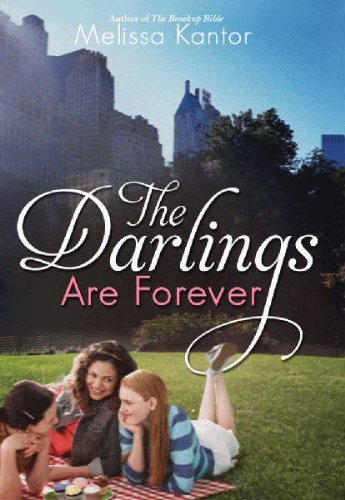
The Darlings Are Forever by Melissa Kantor

The Darlings Are Forever

What it's about (from Goodreads):
Jane, Victoria, and Natalya. Together, they are the Darlings. Best friends forever. They have matching necklaces, their own table at Ga Ga Noodle, and even a shared motto: May you always do what you’re afraid of doing.

When the friends begin freshman year at three different high schools in distant corners of New York City, they promise to live by their motto and stay as close as ever. The Darlings know they can get through anything as long as they have each other. But doing scary new things is a lot easier with your friends beside you. And now that the girls aren’t spending all their time together, everything they took for granted about their friendship starts to feel less certain. They can’t help but wonder, will they really be the Darlings forever?


What I learned: This is another teen book that focuses on friendships between girls and how they'll never change no matter what hardships happen. I didn't have the same kind of friendships as a teen, for whatever reason. I could blame it on going to a private school for sixth through eighth grades then going to the public high school where I didn't know too many people, or changing schools from fifth to sixth grade, from third to fourth grade, from the first half of third grade to the second half of third grade... it goes on. (Really. I went to a total of eight schools before college.) I'm sure that has something to do with it, but really, I just never had a group of close girlfriends or even one super close best friend. In different grades I had different best friends, but never one or two girls that I always spent the weekends with. Even now, I would say that I have a few "best" friends but none of them live in the same state as I do. I never really thought that I was missing out on anything: I had friends, of course. It's only been through books that I learned that apparently, close-knit friendships among girls is relatively common. The three girls in this book all end up going to different high schools and they go through some really rough times in their friendships, but they end up still being best friends. Perhaps it's due to my admitted laziness, but I found that changing schools meant the petering out of friendships (even when changing schools within the same town). It was all a matter of proximity. I think it's interesting to read about this type of friendship because it's something I never had, even though I don't miss it. Friendships can be awesome, but I also loved how this book explored some of the bad things that can happen in friendships (yes, even your best friends can peer pressure you).


If you've read The Darlings Are Forever, what did you learn?

Tuesday, May 3, 2011

Kat, Incorrigible by Stephanie Burgis

Kat, Incorrigible (Kat, Incorrigible, #1)

What it's about (from Goodreads):
Katherine Ann Stephenson has just discovered that she's inherited her mother's magical talents, and despite Stepmama's stern objections, she's determined to learn how to use them. But with her eldest sister Elissa's intended fiancé, the sinister Sir Neville, showing a dangerous interest in Kat's magical potential; her other sister, Angeline, wreaking romantic havoc with her own witchcraft; and a highwayman lurking in the forest, even Kat's reckless heroism will be tested to the upmost. If she can learn to control her new powers, will Kat be able to rescue her family and win her sisters their true love?

What I learned: This was a fun, lighthearted younger teen novel. I thought it took a while to get going and I'm glad there is at least two more in the series (the second is coming out in the U.S. in April 2012 and the third in April 2013) but by the end all kinds of things are happening. I love that Kat stood up for her family and what she thought was right no matter what. She was facing real and possibly evil magic as well as the ruin of her family, not to mention all the scoldings and punishment she would receive from her stepmother and sisters but she chose to keep fighting for what would make her sisters happy. I know that at age 12 I would not have been anywhere as brave as Kat and I definitely wouldn't have put my life on the line for my siblings. Kat understands that family is the most important thing, much more important than how Society perceives you. I learned that no matter how you feel about your family, you can't ever stop being related to them. You may try to hide the truth, but you can't escape it. I know a lot of people don't have good relationships with their family - and mine could be better in some aspects - but there's nothing you can do to completely sever yourself from them.


If you've read Kat, Incorrigible, what did you learn? How important is family to you?